Get Your Videos Cited by AI
ChatGPT, Claude, Gemini, and Perplexity now cite YouTube videos when they answer questions. Paste a URL and find out if yours is showing up — in about 30 seconds.
Check Your YouTube Video's AI Citation Score — Free
Step one · Score
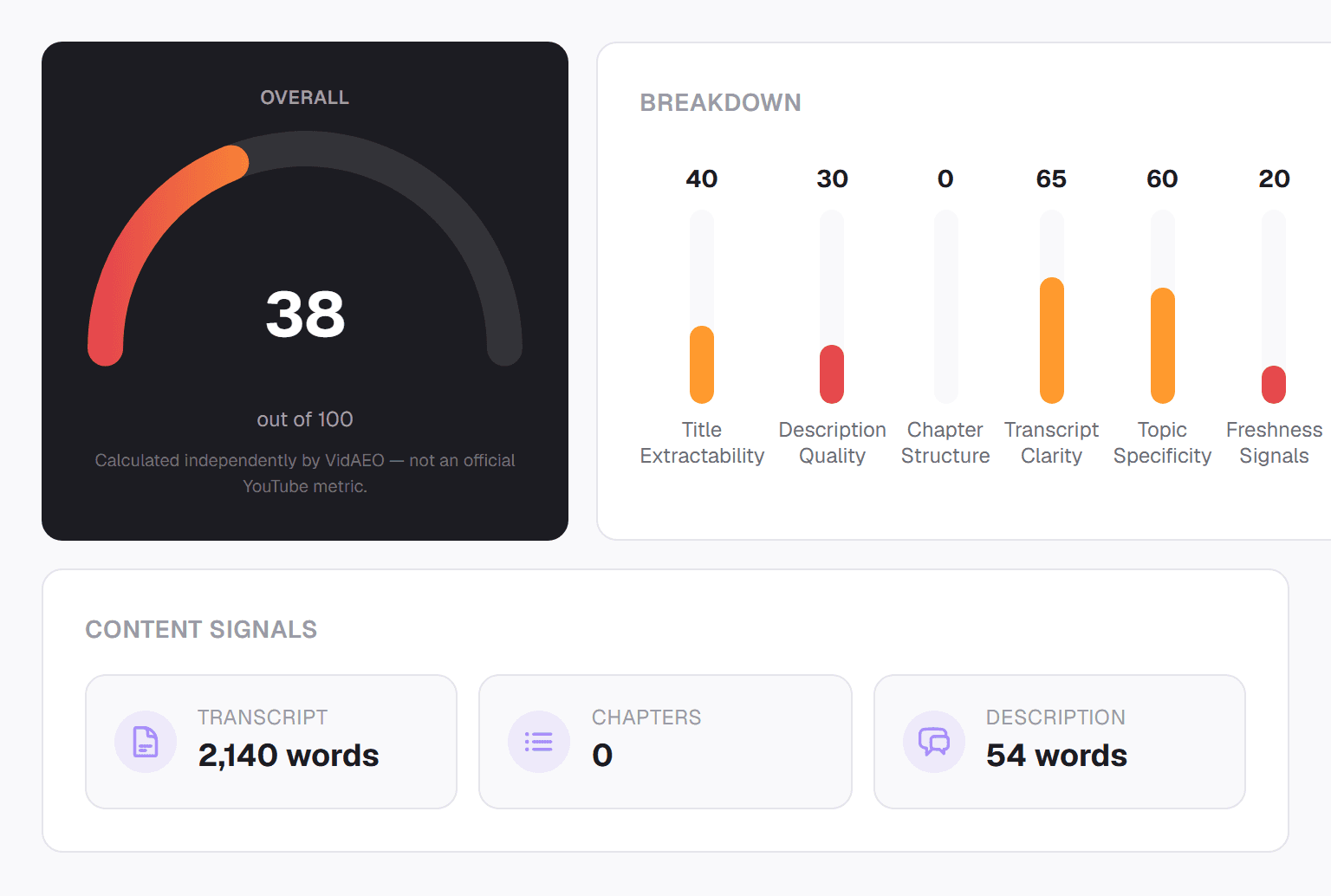
Your score, broken down
Paste a URL and get an overall AEO score plus a breakdown across all six dimensions — transcript clarity, chapter structure, description quality, title extractability, topic specificity, and freshness signals. No guessing what to fix.
Built on real research
What we actually check
Six structural dimensions, checked against five AI engines, backed by an analysis of 100M+ real citations.
40%
of AI-cited YouTube videos have fewer than 1,000 views. Subscriber count barely mattered — clear chapters, direct descriptions, and titles that match how people ask things did.
Source: OtterlyAI, 2025–2026
Step two · Rewrite
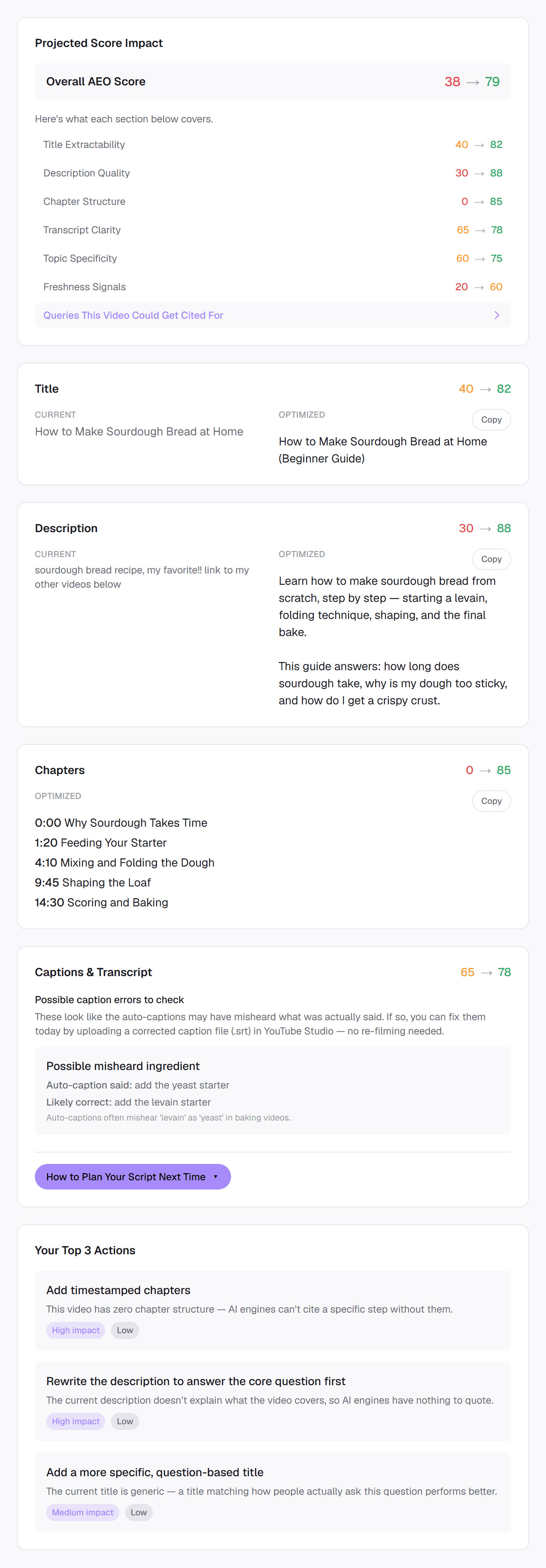
The exact fix, not just the score
Get a rewritten title, description, and chapter breakdown — plus your three highest-impact changes, ranked. Copy and paste straight into YouTube Studio.
Step three · Check
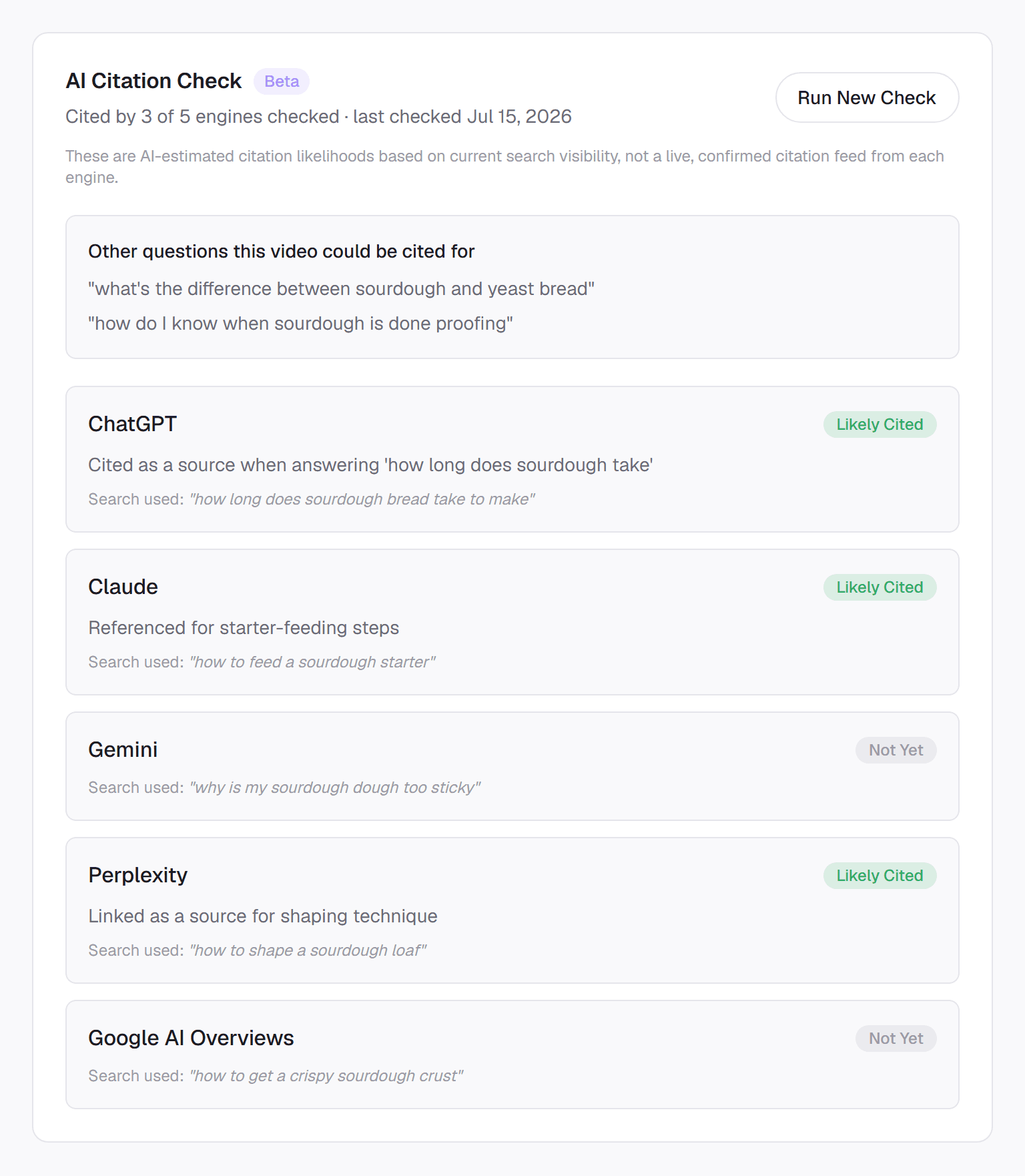
See who's citing you today
We check ChatGPT, Claude, Gemini, Perplexity, and Google AI Overviews against real questions your video could answer — and tell you exactly which ones are citing it.
Step four · Compare
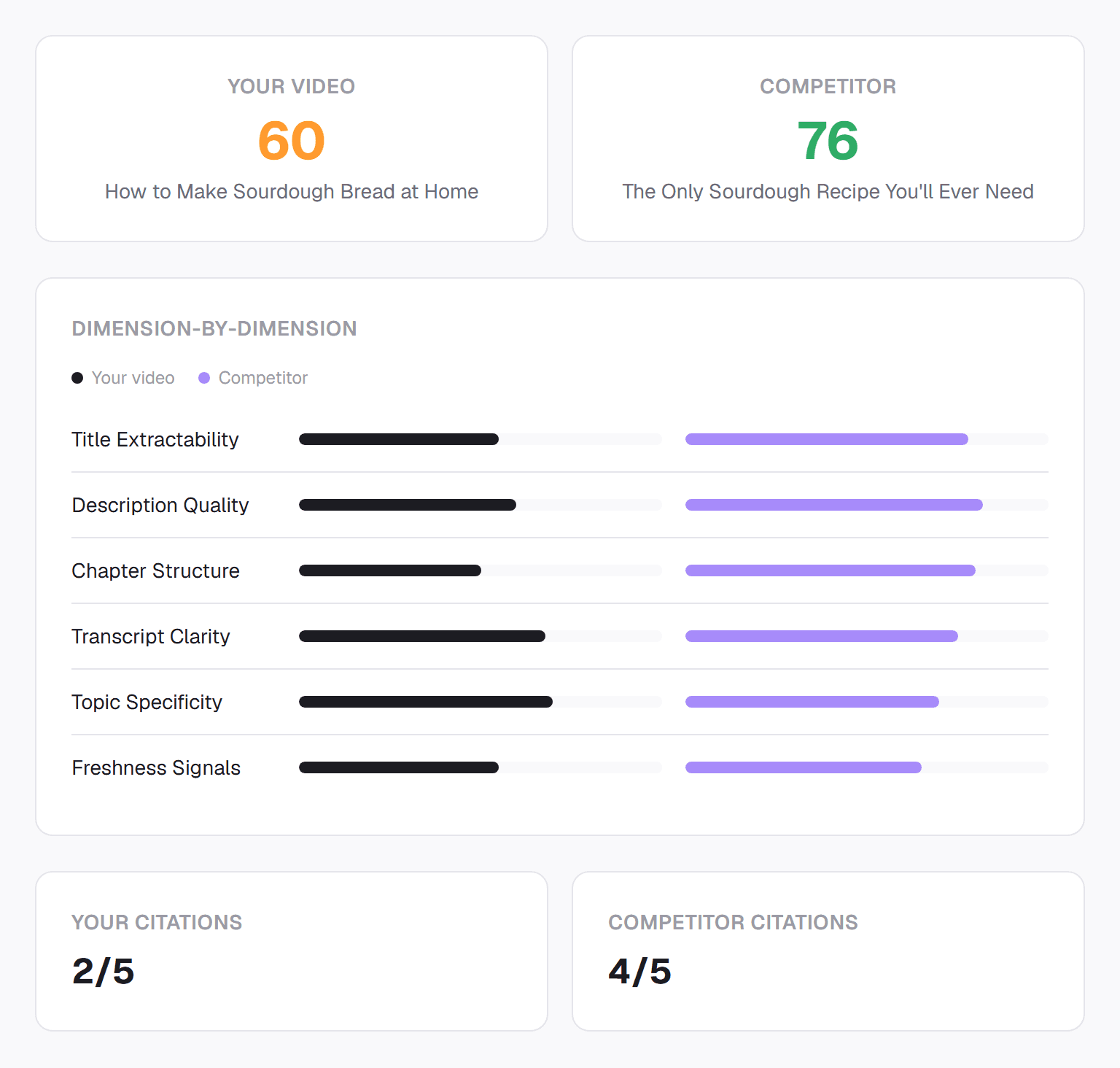
Know exactly what they do better
Pick a competitor's video on the same topic and see a dimension-by-dimension comparison — plus who's winning the citation count.
Step five · Scale
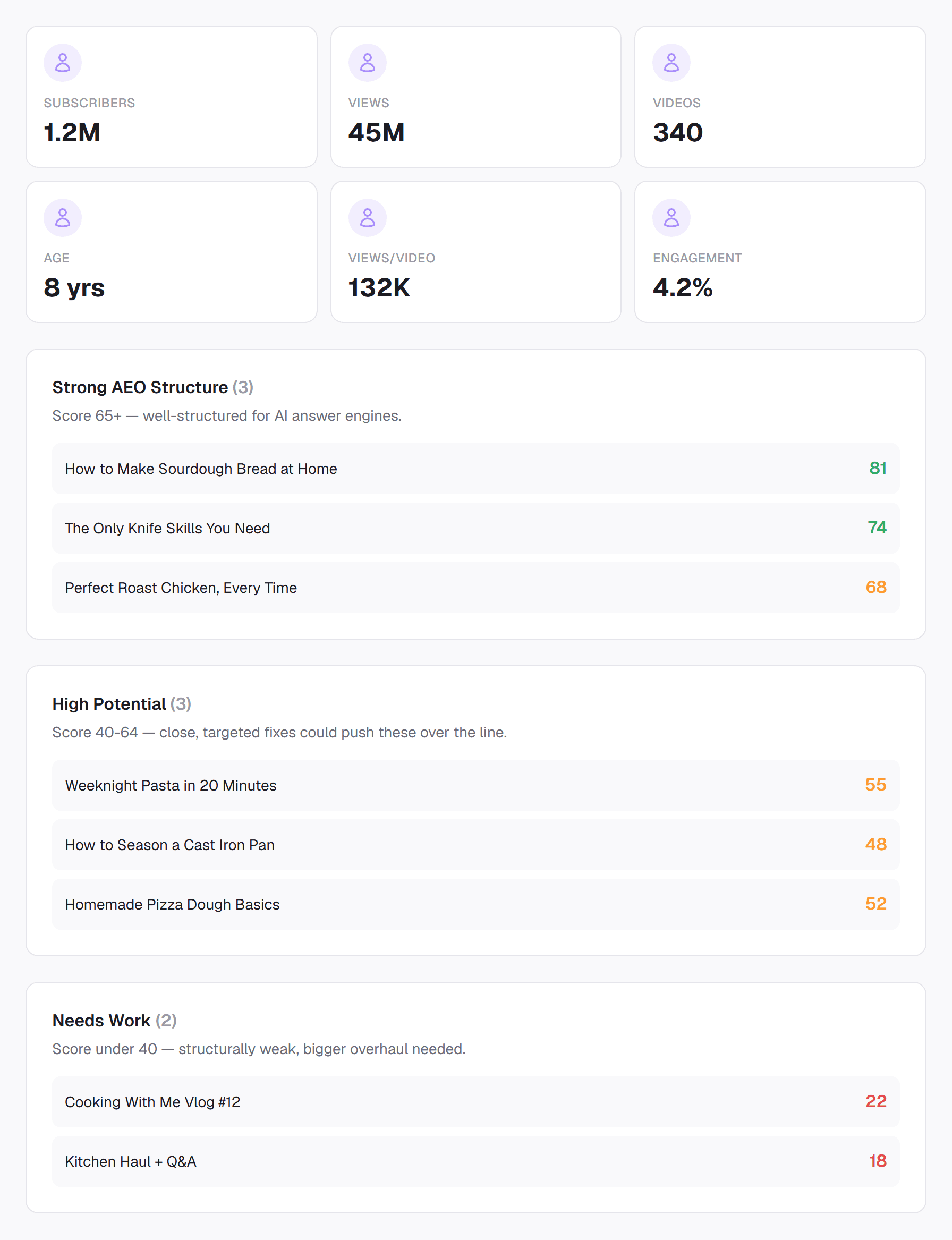
Or audit the whole channel at once
Score every video on a channel in one pass. We group them into Strong, High Potential, and Needs Work, so you know exactly where to spend your time first.
Step six · Plan the next one
Build AEO in before you film
The Script Planning Coach turns everything we've learned into advice for your next video — before you hit record, not after.
State the core question in the first 15 seconds, not after the intro.
“Plan one chapter break per sub-question your video answers.”
Process
How the score works
1
Paste your URL
We pull transcript, chapters, title, and description — nothing typed manually.
2
Get your six scores
Six things AI engines respond to, each scored 0–100.
3
Fix exactly what's wrong
The precise changes to make, ranked by impact.
Plans for every stage
Start free. Upgrade when you need rewrites and citation checks.
Free
$0
- Score 3 videos a month
- See your full breakdown across all six areas
- No rewrites included, just the score
Optimize
$19/month
- Score as many videos as you want, one at a time
- Get a full rewrite for up to 250 of those videos a month: title, description, and chapters
- See your three highest-impact changes for each one
- Copy and paste directly into YouTube Studio
- Script Planning Coach: concrete tips and examples for your next video, based on what held this one back
Track
$49/month
- Everything in Optimize, including full rewrites for up to 500 videos a month
- Run up to 50 citation checks a month — each one checks all 5 AI engines at once
- See exactly which engines cite you, plus related questions you could be cited for next
Audit
$99/month
- Everything in Track, including full rewrites for up to 1,000 videos a month
- Channel Audit: automatically score your whole channel at once — up to 200 videos per audit, 2,000 a month total
- Videos grouped by AEO strength, plus a prioritized 30-day action list for your channel
- Every audited video gets its own full report, with a rewrite available from your monthly rewrite quota above
Questions, Answered
Can you guarantee my video will be cited by AI?
No. We're going to be straight with you: nobody can promise that. AI engines decide what to cite based on a lot of factors we don't control. What we do is show you the structural things that research suggests make a difference — and give you the specific changes to make. After that, it's up to the algorithm.
How does AI decide which YouTube videos to cite?
AI engines read YouTube video metadata — the title, description, transcript, and chapter timestamps. They look for content that answers a specific question clearly, quickly, and with well-structured text around it.
Does my YouTube channel need to be big to be cited by AI?
No. Research shows that 40% of YouTube videos cited by AI have fewer than 1,000 views, and subscriber count shows near-zero correlation with citation frequency.
How does citation tracking work?
We run topic-based queries related to your video across the major AI engines — ChatGPT, Claude, Gemini, Perplexity, and Google AI Overviews — and check whether your content appears in the responses. Each check is a snapshot as of the moment you run it — rerun anytime to see if anything has changed.
What is the difference between YouTube SEO and YouTube AEO?
YouTube SEO optimizes your videos to rank in YouTube's own search results. YouTube AEO optimizes your videos to be cited by external AI engines like ChatGPT, Gemini, and Perplexity when they answer questions.
How do YouTube chapters affect AI citations?
Significantly. Timestamped chapters with descriptive headings allow AI engines to cite specific sections of your video rather than the whole thing.
When does my usage reset?
All usage limits reset on the first of each calendar month, regardless of when you signed up.